TheScreen
The trick is not tonal. It is spatial: break the image into dots of varying size — larger where it is dark — and let the eye do the averaging at reading distance.
Talbot’s
veil, 1852
William Henry Fox Talbot filed British patent no. 565 in October 1852. Buried in it is the idea the whole industry would eventually run on: interpose a screen — he suggested black crape, gauze or muslin — between the negative and the plate, and the continuous tone breaks into a texture a press can carry.
Talbot had the concept roughly thirty years before anyone made it pay. He never produced a commercial halftone.
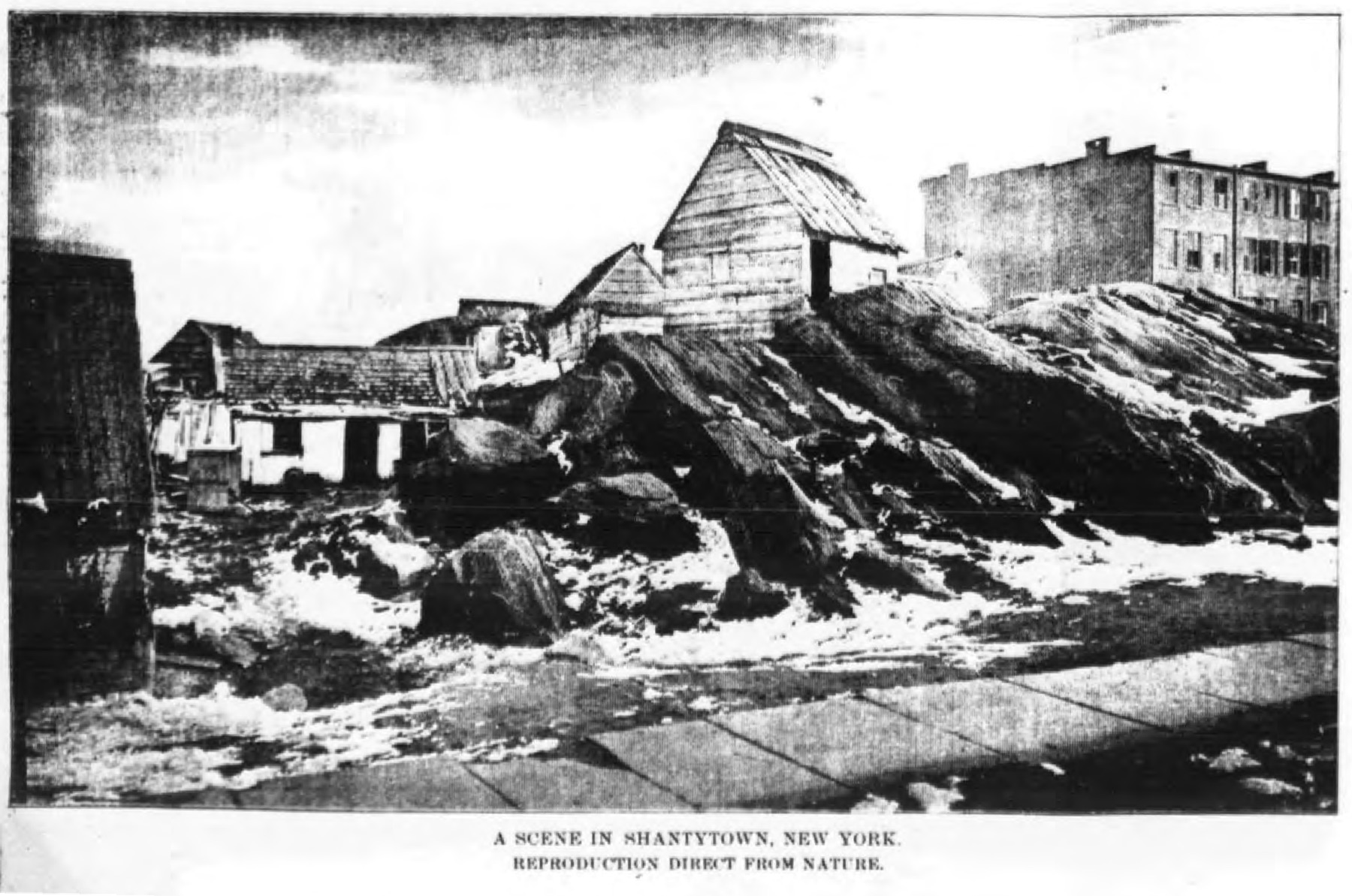
A Scene in Shantytown, New York — printed in the New York Daily Graphic on 4 March 1880, from a photograph, by Stephen H. Horgan. Widely cited as the first halftone photograph reproduced in a newspaper, though the claim to being first has been contested.
Look closely and the tone is entirely dots.
Ives, 1881 — and
what he actually did
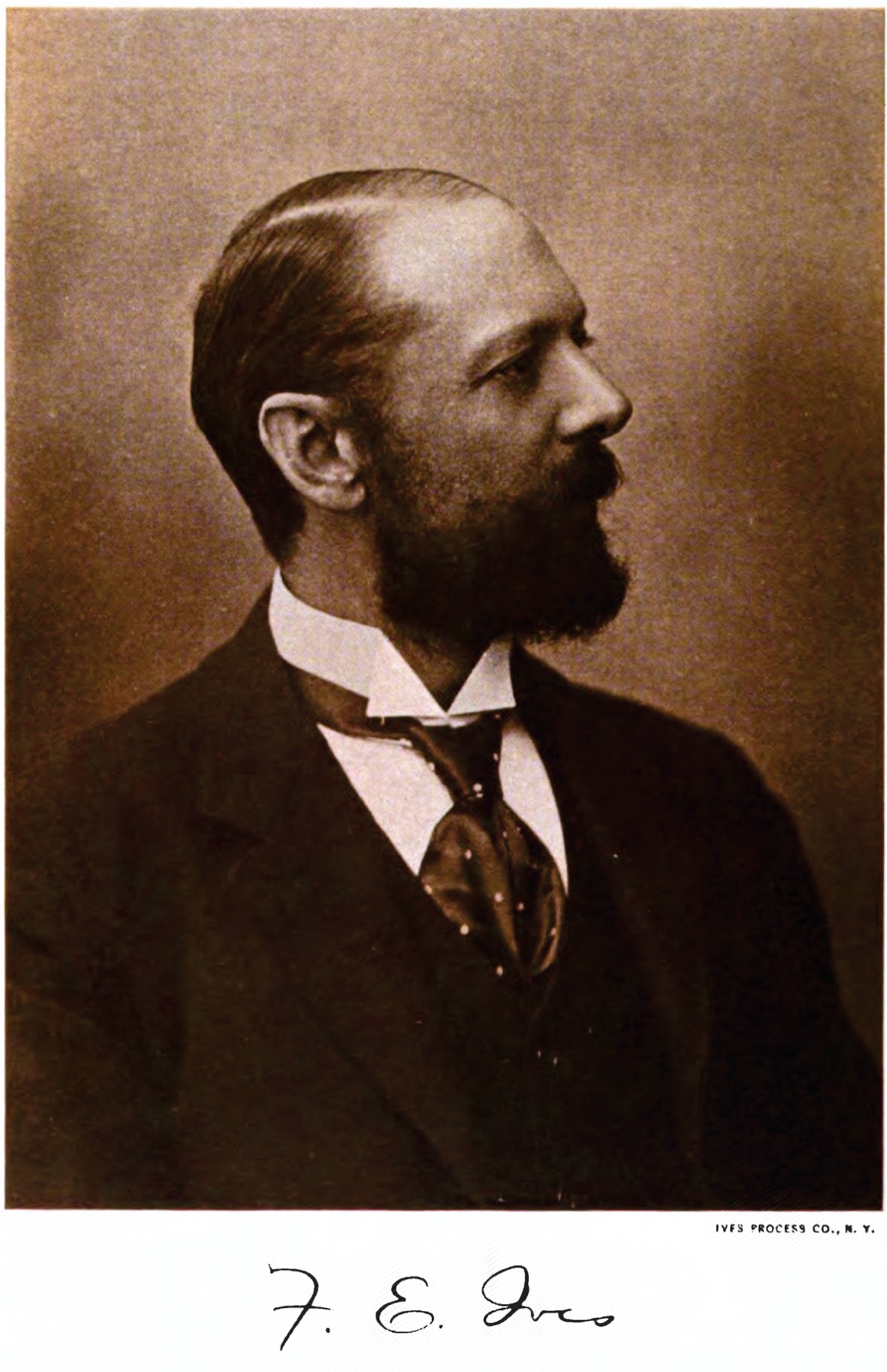
Frederic Eugene Ives ran Cornell’s photographic laboratory from 1874 to 1878, then moved to Philadelphia, where in 1881 he patented the first commercially successful halftone method. Here is the detail most accounts flatten: that process used no screen at all. It worked by swelling gelatin into a relief, casting it in plaster, and pressing the cast against an inked rubber grid — the dots came from the grid, not from a screen over the negative. Ives adopted the crossline screen he is remembered for only later. The signature on the portrait is his.
Fig. 2 · 1905. Frederic Eugene Ives
The Levys
grind the glass
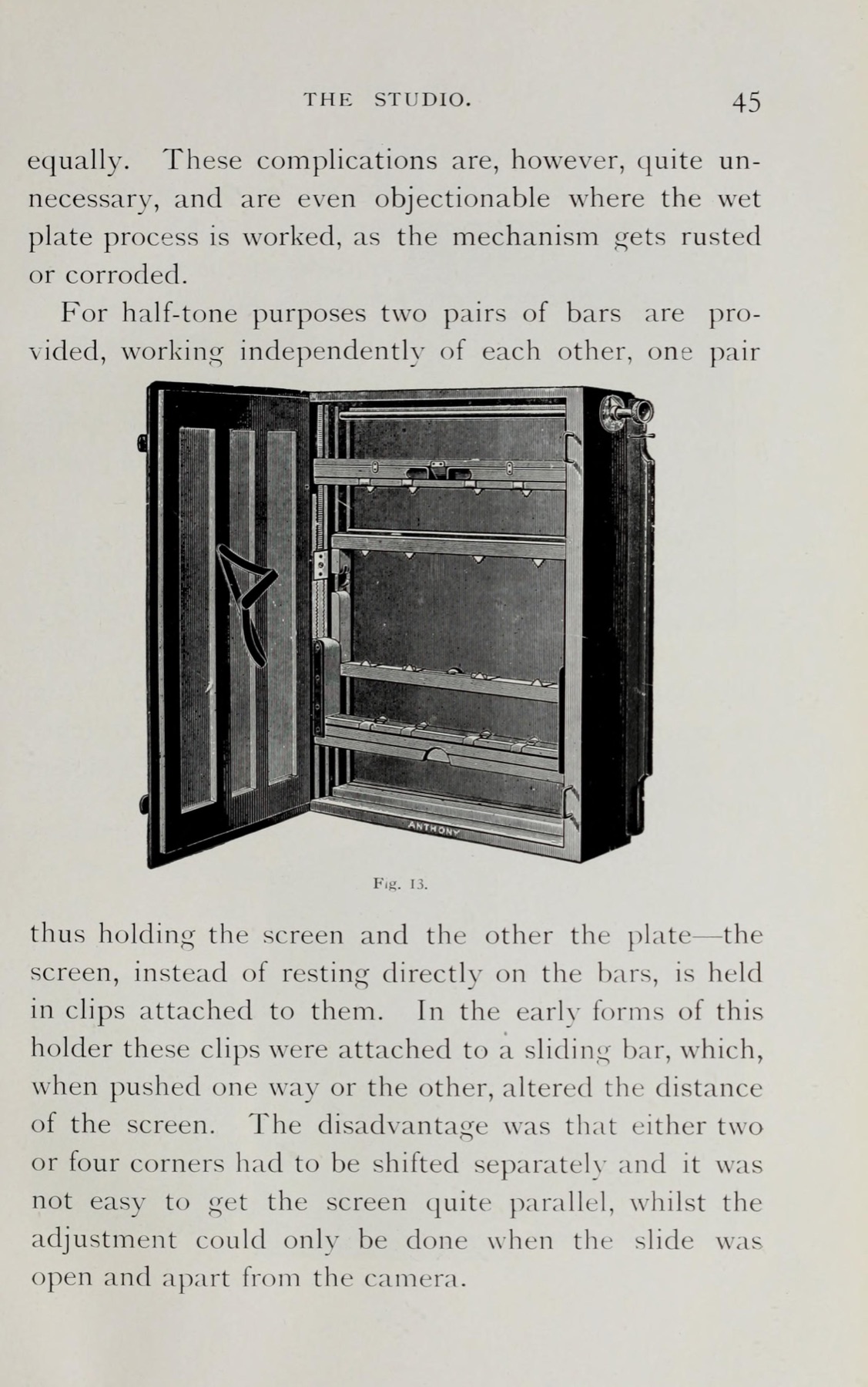
The screen that industrialised the process came from two brothers in Philadelphia. Louis Levy and Max Levy coated optical glass with lacquer, ruled it with a diamond point, etched the grooves in hydrofluoric acid, filled them with something opaque, then cemented two such plates together with their lines crossing at right angles. The Science Museum in London holds an eighty-five-line Levy screen from 1893 — glass ruled to a precision that made photographs printable. The apparatus, from a 1904 manual, holds that screen in clips at a measured distance from the plate: the gap is what turns a ruled grid into round dots.
Fig. 3 · 1904. Screen and plate holder
Meisenbach
turns the screen
In Munich, Georg Meisenbach was granted German patent 22244 on 9 May 1882 for a process he called Autotypie. His method used single-line screens that were physically rotated during the exposure, producing a crossed effect from a single ruled plate.
He founded the Autotype Company in Munich the following year, and was the first to make relief halftones a commercial success in Europe.
Howcoarseis coarse
Screens are measured in lines per inch. Newsprint takes a coarse screen — absorbent paper spreads ink, and fine dots simply fill in and go black. Coated stock takes a fine one.
The 1904 manual on the shelf beside these images makes the argument better than any diagram: the same photograph of the Flatiron Building, printed at sixty, seventy-five and eighty-five lines, then again at one hundred and seventy-five, two hundred, and four hundred.
Past roughly three hundred lines the screen leaves human vision altogether, which was always the objective — the dot is not the point, the disappearance of the dot is.
The same
face, twice
One photograph, screened twice by this site’s own shader. Twenty-eight cells across on the left, one hundred and eighty on the right. Nothing else changes — same image, same inks, same contrast. Only the ruling.
Left is what newsprint demands and what newsprint costs you: dots you can count, tone assembled in front of your eyes rather than behind them. Right is coated stock, where the structure drops below what vision resolves and the picture goes back to being a photograph. Every printer since the Levys has picked a point on that line, and the paper picks it for them.