FourScreens,OneSheet
One screen prints a gray photograph. Color needs four — cyan, magenta, yellow and black, each its own screen, each printed over the last, all on the same sheet.
Gray collapses to black
and the thirty-degree rule
Drag the color toward the neutral axis and watch it happen: cyan, magenta and yellow all fall to exactly zero, and black carries the entire image. A grayscale photograph prints as one screen; three of the four plates sit idle.
It is why the scene behind the homepage is tinted warm in its shadows rather than neutral gray. A neutral scene would print on the black plate alone, and the other three screens would have nothing to say.
Give all four something to carry, though, and a second problem arrives with them. Four grids stacked on one sheet interfere: where two regular patterns overlap slightly out of step, they beat against each other and produce a third pattern that was in neither of them — moiré, coarse ugly bands rolling through a photograph.
The fix is angle. Rotate each screen so that no two beat at a visible frequency. And here the geometry is unforgiving: a square lattice repeats every ninety degrees, so there are only ninety degrees to share. Three inks can sit a comfortable thirty degrees apart. The fourth cannot — it must take a fifteen-degree penalty.
Yellow takes it. Not because yellow matters least, but because yellow against white is the one beat your eye cannot see. Which is how the four numbers get fixed for a century: cyan fifteen, magenta seventy-five, yellow zero, black forty-five.
Why there is
a black plate
In theory cyan, magenta and yellow together absorb everything and give you black. In practice they give you a muddy brown, at triple the ink, with any misregistration showing as color fringing on every letter of text.
So printing adds a fourth plate. The rule is arithmetic: black takes whatever all three channels have in common, K = 1 − max(r, g, b), and the color plates carry only what is left over.
Tightest beat1.3 cellsY–B
“Eve” (2008) by Alex Prager.
Turn the
screens
Four dials, one per plate. Standard angles produce a rosette — the small flower-like cluster that print people look for on press.
Now push any two plates within a couple of degrees of each other. The beat wavelength jumps from about two cells to nearly thirty, and the rosette blows up into bands across the whole image. The rosette was never the absence of moiré. It is moiré, tuned so fine your eye reads it as texture.
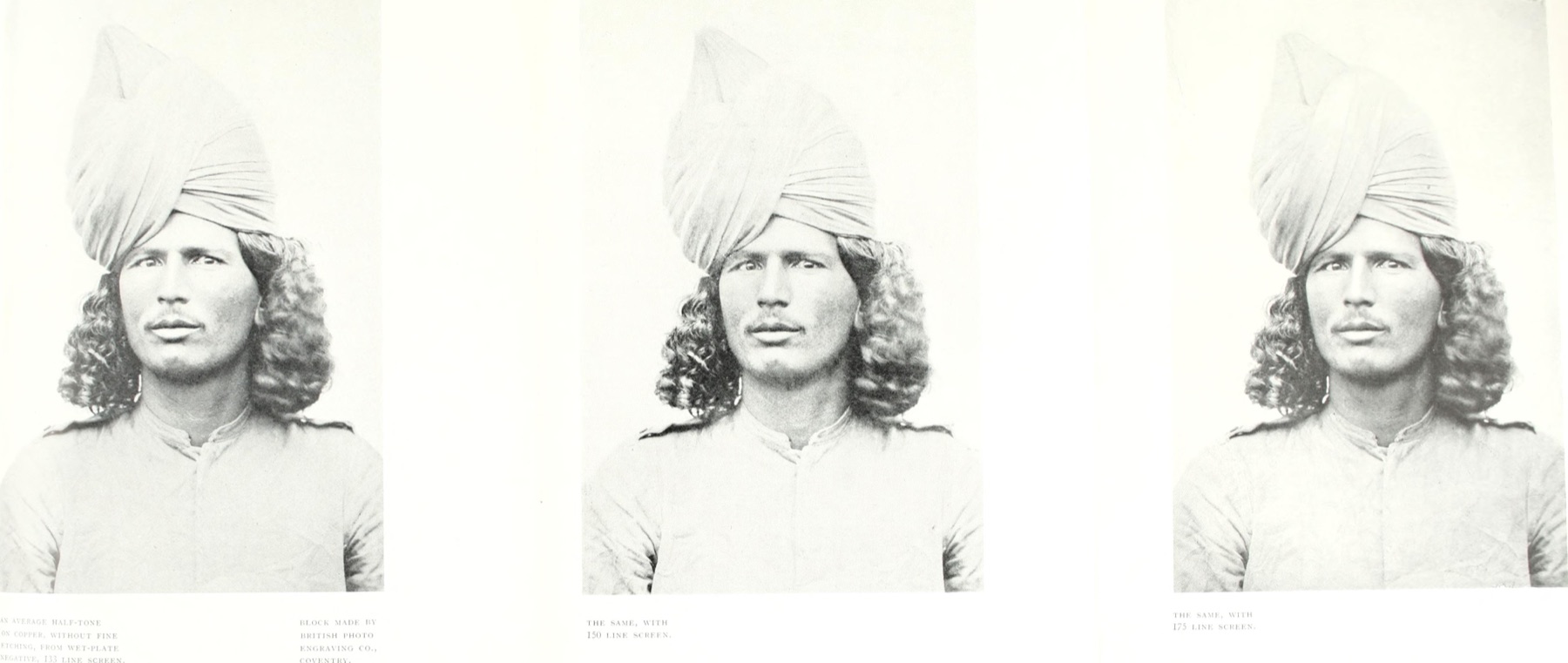
The same portrait, unscreened, then at one hundred and thirty lines, then at one hundred and seventy-five. From the 1904 manual — the argument for fine screens, made in the only medium that can make it.