TheBinaryPress
A printing press is a binary device. It carries one film of ink at one density: it can put ink somewhere, or leave the paper bare. There is no dial for forty per cent gray.
One ink,
one density
This is not a limitation anyone designed. It falls out of the physics: a plate is inked, the ink transfers, and what transfers is ink — opaque, uniform, the color it already was. A plate cannot be inked with different shades of gray.
So for the first four centuries of printing, a photograph could not be printed. Not badly — at all. What appeared in newspapers and magazines instead was something else entirely: a drawing of a photograph, cut into wood by a person.
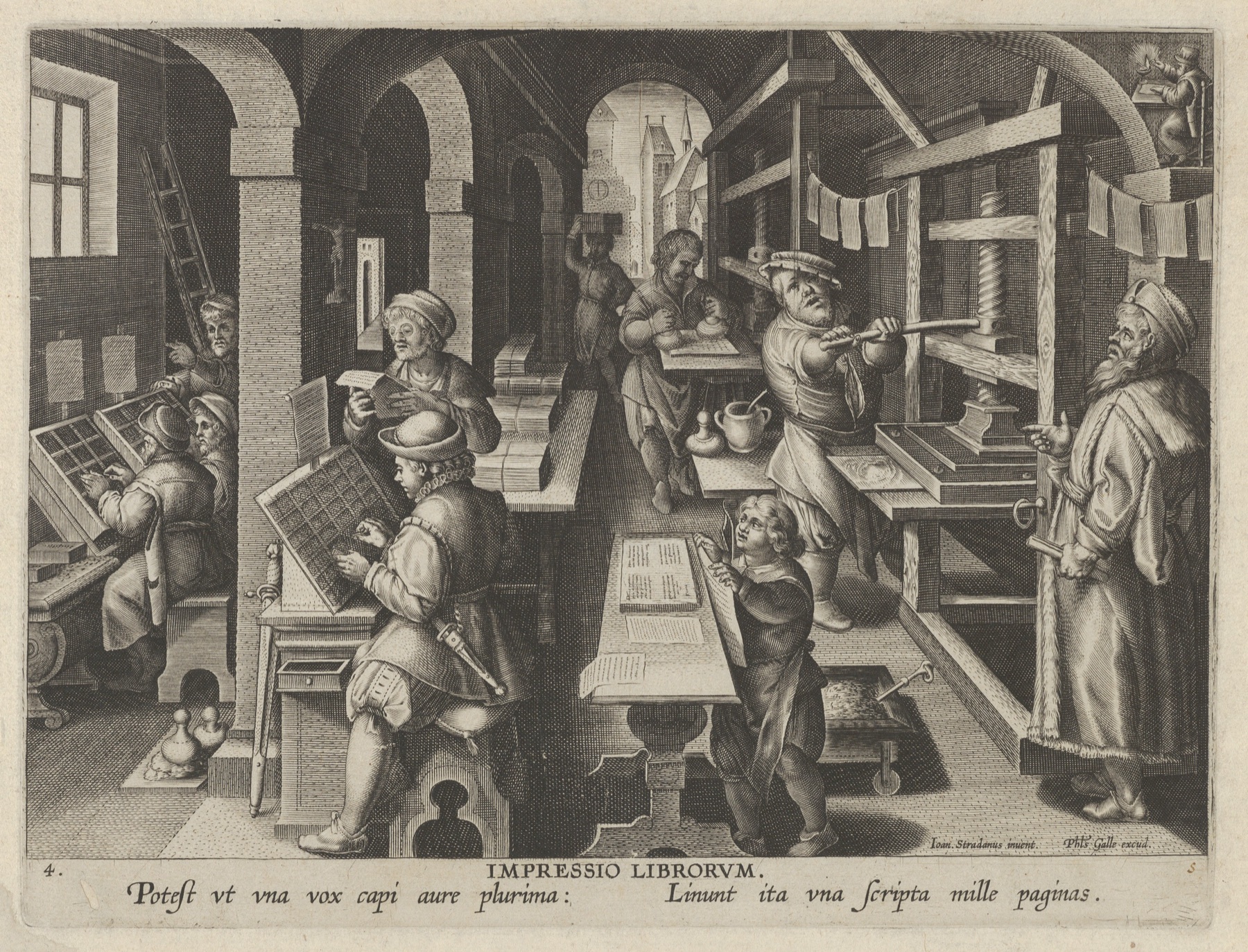
The press as it stood around 1600, in Stradanus’s engraving: compositors at the type cases, the great screw press mid-pull, damp sheets hung to dry. The mechanism that would still be printing pictures three hundred years later — and still unable to print a photograph.
The engraver
in the middle
Wood engraving was the workhorse of the illustrated press from the 1830s to the 1890s. A drawing was transferred onto a block of end-grain boxwood and everything that was to stay white was cut away, leaving a relief surface that could be locked up beside metal type and printed in a single pass.
Boxwood only grows so wide, so large images were assembled from small blocks bolted together — which conveniently allowed a team to carve one picture at once. Harper’s divided illustrations into roughly two-inch squares, gave each square to a different engraver, screwed the blocks together afterwards, and handed the seams to a finishing engraver to reconcile.
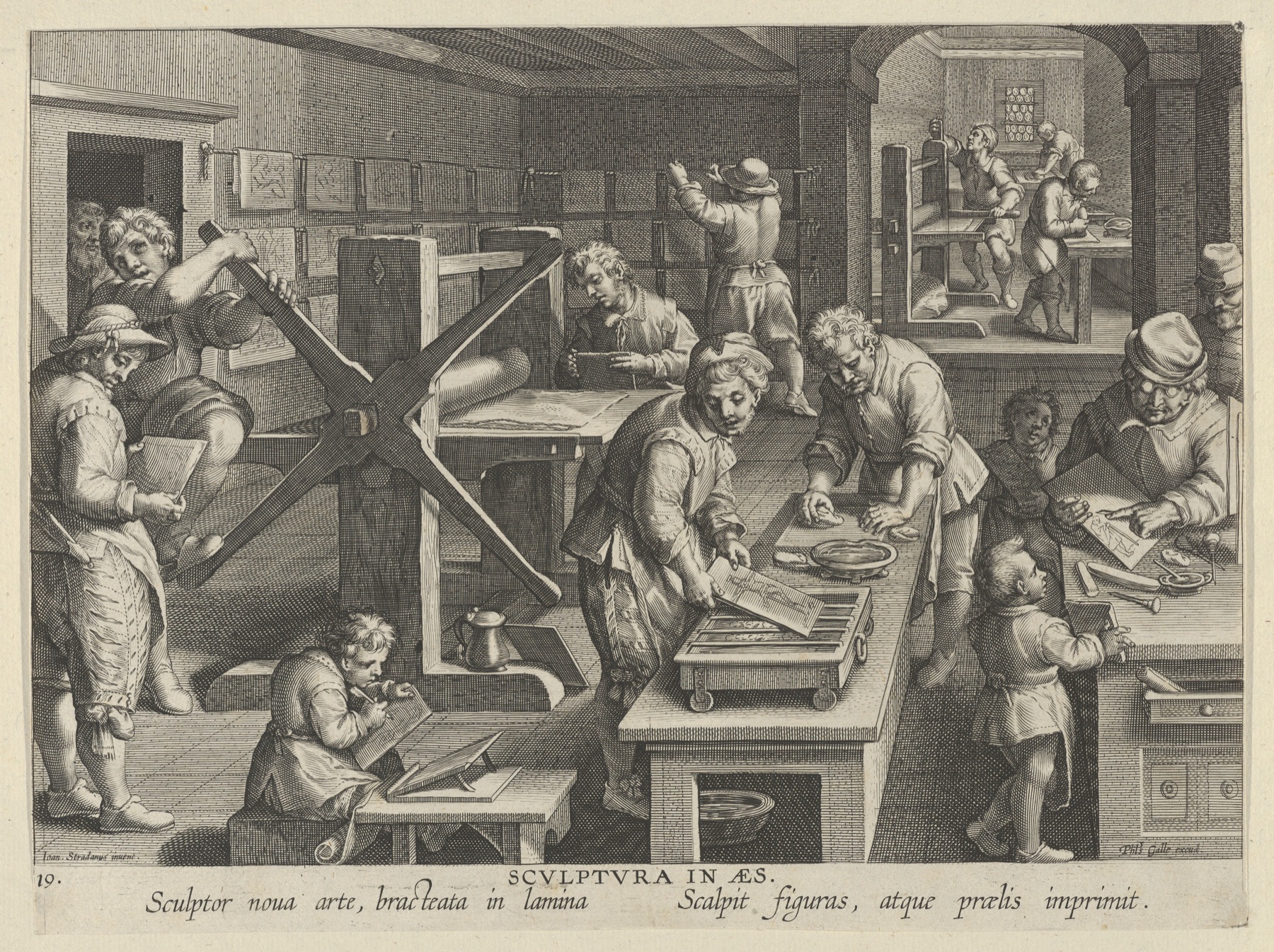
Copper engraving, from the same series. Intaglio plates printed on a separate press from the type, so they could not economically share a page with text — and copper wore out after about four thousand impressions.
Every image was
a translation
This is the part worth sitting with. Before halftone, every printed image passed through a human hand. Even when the source was a photograph, the photograph was printed onto the woodblock and then cut by an engraver, whose signature sat on the page next to the artist’s.
What readers saw was never the photograph. It was an engraver’s reading of it — his decisions about which lines carried the tone, where to lose detail, what a face was doing.
Then it ended, quickly. By 1895 most illustrations in books and periodicals were halftones or line-blocks. Commercial wood engraving did not decline; it stopped.